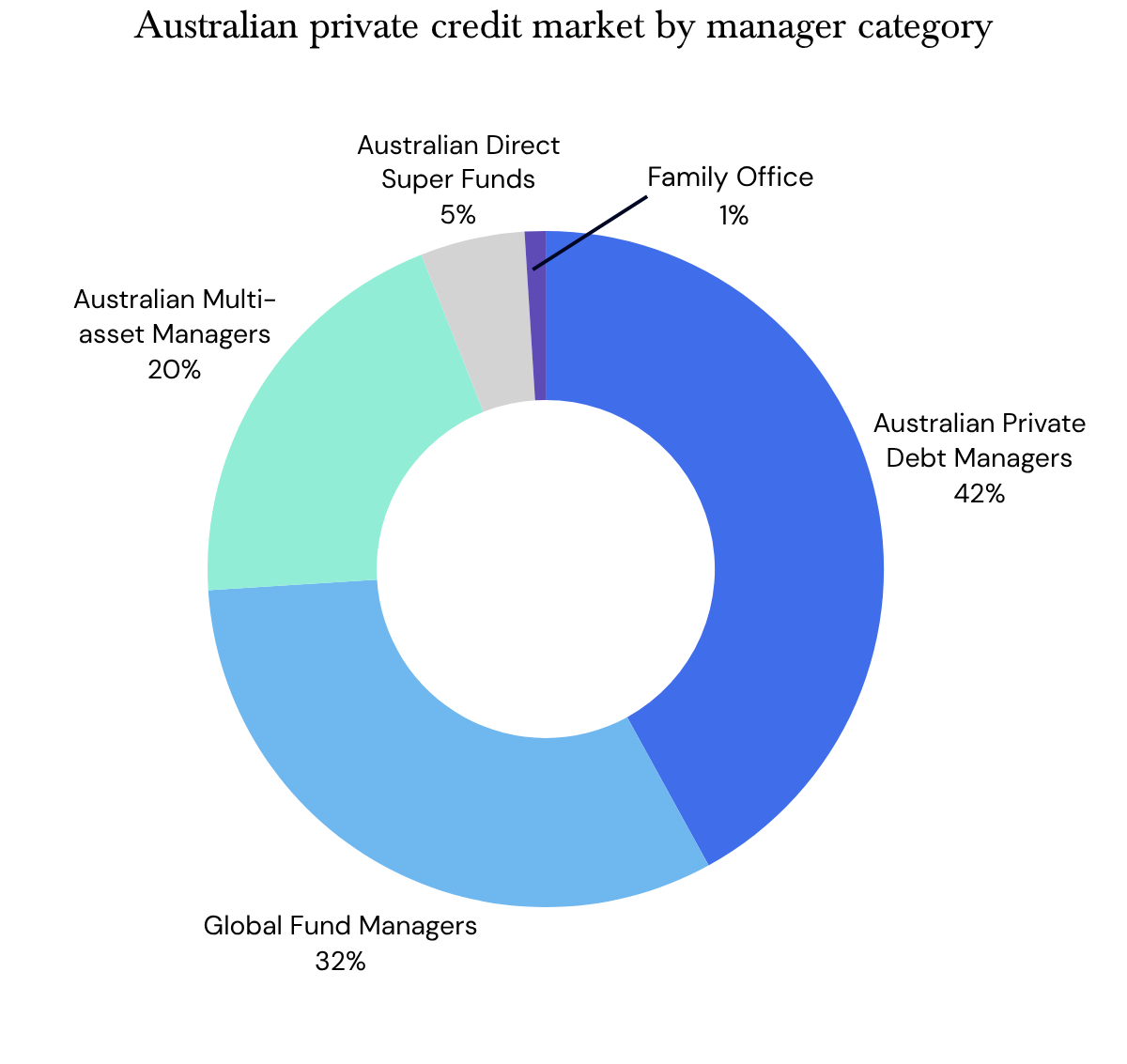
Source: Private Credit in Asia 2.0, AIMA (2025)
Manager due diligence and selection is thus a critical step especially given we see market dispersion over the next 12 months. Managers with well-defined credit strategies and products, consistent performance and through the cycle experience are expected to perform strongly.
Why advisers and their clients are paying attention.
For an income-focused portfolio, private credit offers a combination that is difficult to replicate in listed markets:
- Contractual income
Returns come primarily from interest paid by borrowers under loan agreements, not from the listed company’s decision to pay distributions (or not).
- Floating rate exposure
Most loans are priced over a base rate, so income tends to move with interest rates rather than being eroded by them – a useful counterweight to fixed interest.
- Seniority, security and risk management
Well-structured loans sit higher in the capital structure, backed by the lender’s claim on cashflows and assets; and an ongoing covenants compliance obligation on the borrowers, thus providing a layer of protection that equities do not.
- Diversification
Returns are driven by individual borrowers’ performance, giving genuinely low correlation to the Australian listed market’s concentration in banks and miners.
The catch: private credit is not one thing.
Private credit is not a homogeneous product.
ASICvi estimates the key components of Australian private credit market as:
- Real estate lending: 40-60%
- Corporate lending: 20-40%
- Asset-based / securitised: 10-30%
A significant portion of the private credit market is thus real estate related lending. Advisers would benefit from seeking information from a private credit manager regarding the percentage of their investments in real estate during due diligence. This will help to bottom out the actual real estate sector concentration across their clients’ portfolios if advisers were to allocate to such managers.
Another useful lens is direct versus allocated/secondary loans. An experienced private credit manager directly originating, structuring and risk managing its loans has better control on lending than a manager participating in a large syndicate or buying loans in secondary markets. Control becomes crucial, should the borrower underperform, and typically has a direct correlation to the ability of the manager to take corrective action to preserve the quality of the loan and hence investor capital.
In September 2025, ASIC published REP 814, the most detailed public review of the Australian market to date. ASIC’s central message was nuanced: private credit “done well” plays a valuable role in the economy, complementing banks and public markets. But it also drew a sharp line between the institutional end of the market (which generally demonstrates sound governance and transparent valuation and fee practices) and segments where practices “do not compare favourably against international practice.” Among the concerns it flagged were the following:
- Real estate concentration
Real estate lending represents the largest sector of Australia’s private credit market, roughly half of the estimated A$200 billion market, with a concentration in higher risk construction and development lending.
- Transparency gaps
Inconsistent disclosure of portfolio mix, impaired loans and related party transactions.
- Valuation
Closer inspection in relation to frequency, independence (or at least reviewed by independent third party) and the basis of valuation (especially for real estate lending); and recognition of impairment.
- Fee conflicts
Fee structures that include borrower-paid fees retained by the manager, sometimes worth several times the disclosed management fee, and special purpose vehicles used to capture excess margin for the manager, not the investor.
- Loose terminology
Inconsistent use of terms like “investment grade”, “senior” and “LVR” that can understate true risk, and, in some real estate funds, distributions are paid from capital rather than income.
None of this is a reason to avoid the asset class. It is a reason to educate yourself and look hard at how and who is managing the money.
How advisers can separate quality from risk.
In a shrinking, concentrated listed market, the structural case for private credit is compelling but the returns won’t be evenly distributed. The winners will be the advisers and clients who treat manager selection as a priority and insist their credit manager looks and operates like the institutional end of the market that ASIC praised, regardless of which investor segment the fund is offered to.
A practical due diligence checklist, drawn directly from ASIC’s “good practice” benchmarks:
- Independent, regular valuations — ideally independent quarterly valuations, not internally set marks.
- Full fee transparency — every fee, including borrower-paid fees, disclosed as a percentage of fund assets.
- Loan-level portfolio reporting — quarterly disclosure covering impairments, PIK loans, arrears and the source of distributions (income, not capital).
- Governance independence — valuation function that is genuinely independent of the people originating and risk-managing the deals.
- Clarity on what’s being lent against — and how concentrated the book is in higher risk segments such as property construction and development.
- A track record through a full cycle — performance in difficult conditions, not just a benign one.
Where Privity fits.
Institutional grade quality is what we aim for.
Privity Credit is a specialist manager focused on direct lending to mid-market corporates across Australia and New Zealand, providing growth and acquisition capital through structured, secured and asset backed loans. Over a 12+ year history and a team whose experience spans both favourable and difficult markets, we have deployed more than A$1 billion, with our earlier closed funds achieving their target returns and double-digit IRRs.
Two design choices matter most through a credit lens.
Unlike many Australian private credit managers, we exclude property development and construction, instead building a diversified portfolio across industries, loan types and borrowers. The absence of property exposure directly addresses the single largest risk ASIC identified in the market.
We have an independent expert on the Valuation Committee to ensure the people managing the loans are not the people valuing them.
The funds are available to wholesale investors on a growing list of wealth platforms and we report transparently because we believe that is what allows advisers to allocate with confidence.
What this means for portfolio construction moving forward.
The migration of capital into private markets, and in particular into private credit, is one of the most significant shifts underway in markets today. Much of the attention is on the yield. The more enduring advantage for advisers will come from choosing the managers built to deliver it reliably, transparently and through the cycle.
This article is general information only and does not constitute financial advice or an offer of any product. It is intended for persons who qualify as wholesale clients under section 761G of the Corporations Act 2001 (Cth). Past performance is not indicative of future performance.
[i] https://www.abs.gov.au/statistics/economy/business-indicators/counts-australian-businesses-including-entries-and-exits/latest-release
[ii] https://www.asx.com.au/markets/trade-our-cash-market/directory
[iii] https://www.asic.gov.au/regulatory-resources/find-a-document/reports/rep-823-advancing-australia-s-evolving-capital-markets-discussion-paper-response-report/
[iv] https://www.asic.gov.au/regulatory-resources/find-a-document/reports/rep-807-evaluating-the-state-of-the-australian-public-equity-market-evidence-from-data-and-academic-literature/rep-807-evaluating-the-state-of-the-australian-public-equity-market-evidence-from-data-and-academic-literature-html-version/
[v] https://www.aima.org/article/press-release-strong-growth-sees-private-credit-market-reach-us-3-5-trillion.html
[vi] https://download.asic.gov.au/media/z2tnnasb/rep814-published-22-september-2025.pdf